

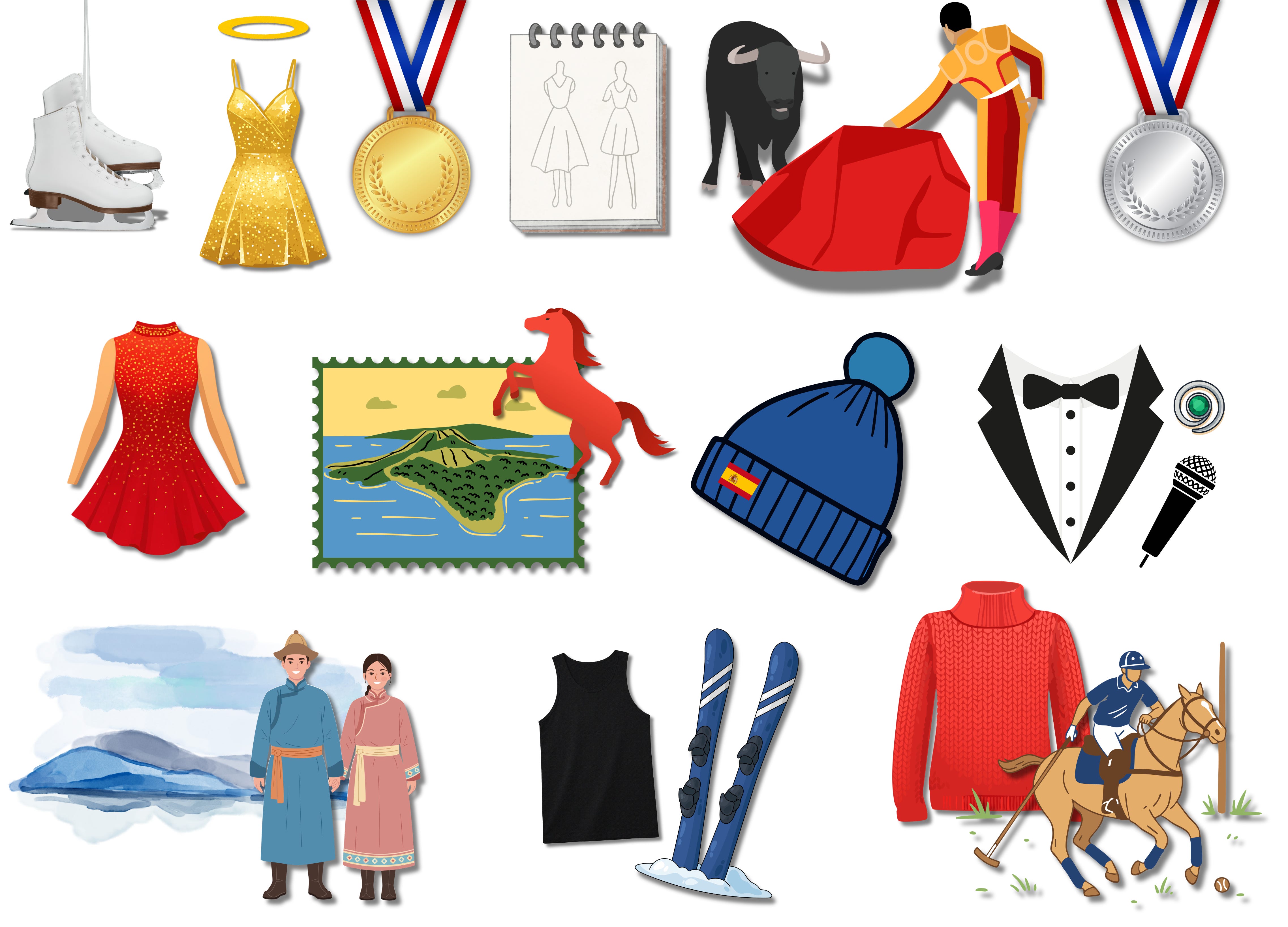
The 2026 Winter Olympics wrapped up Sunday, which means it’s time for a roundup of the best fashion moments, from eye-catching opening ceremony looks to wearing gold to win gold. The games took place in Milan, a fashion powerhouse, so it’s only fitting that so many styles took the spotlight.
1. Figure skater Alysa Liu dresses for gold
Alysa Liu garnered an abundance of public and media attention before the games even began. But people weren’t just talking about her comeback to skating or how she was favored to medal: They were also talking about her hair.
Since 2023, Liu has added a new bleached gold ring to her hair every year, creating a golden halo effect.
Was it foreshadowing? Maybe. But what could definitely be considered foreshadowing was Liu fittingly deciding to wear a custom gold dress designed by Lisa McKinnon when she won gold. From her halo hair to her dress and the medal around her neck, Liu was golden.
2. Ice dancer Madison Chock turns the rink into her runway
Madison Chock made headlines not only for taking home Olympic gold and silver, but for the costumes she designed for the Games. This included the looks she and Evan Bates, her skating partner and husband, wore.
Most notably, Chock designed the pair’s silver medal performance attire that costumed Bates as a bull and Chock as a Flamenco-inspired matador.
Competing for Team USA also didn’t stop her from sharing her designs with competitors from Spain, Georgia, and Australia.
Read my full article on Chock’s designs here:
Olympic ice dancer Madison Chock turns the rink into her runway with her designs on display in Milan

Thanks for reading The Handwritten Edit! Subscribe for free to receive new posts and support my work.
3. Figure skater Deanna Stellato-Dudek stuns in custom Oscar de la Renta
At 40, Team Canada’s Deanna Stellato-Dudek made history by becoming the oldest woman to win a figure skating world title. And last year, she became the first woman since Surya Bonaly in 1998 to do a backflip in her routine. Now 42, she’s the oldest woman to compete in figure skating at the Olympics in nearly a century.
But she also made history in Milan by being the first athlete to collaborate with Oscar de la Renta. She wore two custom looks by the label, including a flamenco-inspired red dress with over 200,000 hand-sewn glass beads and a champagne-colored Art Deco beaded dress inspired by Oscar de la Renta’s spring 2026 collection, according to The New York Times.
4. Mongolia’s historically rich Opening Ceremony outfits
Mongolia is no stranger to winter, sitting in the Central Asian highlands, and it made that known with its Parade of Nations entrance. Amid puffer jackets and beanies, the athletes donned long robes, inspired by traditional deel garments from the Great Mongol Empire of the 13th-15th centuries.
The looks came with the tagline: “What We Carried Through Winter - We Carry to the World.”
Goyol Cashmere appropriately designed the garments, as historically, Mongolia’s nomadic people used cashmere to protect themselves from the bitter cold winters.
“Rather than merely blending traditional garments with modern design, this collection aims to reintroduce the ancient Mongolian clothing culture—an inseparable part of our great history and cultural heritage—to the contemporary world,” Goyol Cashmere said.
5. Haiti’s resilient hand-painted uniforms
Haiti had only two athletes representing the nation: alpine skier Richardson Viano and cross-country skier Stevenson Savart. But that didn’t stop it from making an impact at the games.
The country stood out with the only hand-painted Olympic uniforms, inspired by the Haitian art of Édouard Duval-Carrié. The attire features a vibrant color scheme of a riderless red horse in a tropical scenery with a blue sky.
The women delegates’ uniform are especially stunning with a long puffer skirt that serves as a large canvas for the painting and a traditional tignon headwrap, symbolizing how women in slavery were forced to cover their hair.
The uniforms were made in Italy by Italian-Haitian designer Stella Jean — the perfect symbolic representation of Haiti on a global stage in Milan.
“These uniforms are not an exercise in style,” Jean said to The Guardian. “Every centimeter of fabric carries the duty to tell a story — and the will to endure.”
One of the biggest stories these uniforms told was with what was missing on the final product: the revolutionary hero Toussaint Louverture riding the red horse as depicted in Duval-Carrié’s artwork.
The original version of the ski suits included Louverture but did not comply with the International Olympic Committee’s guidelines on athlete expression, which bars “demonstration or political, religious, or racial propaganda.”
“For 24 hours, I was in total despair,” Jean said in the Guardian interview. “We had no budget, no time and this was our only chance to show Haiti in a positive light.”
This led to Viano and Savart receiving their uniforms the night before the Opening Ceremony after artists worked relentlessly to modify the hand painted design.
In the end, Jean concluded, “His absence spoke louder than his presence.”
6. Ralph Lauren returns
Would it be the Olympics without Ralph Lauren? Team USA’s 2026 uniforms showed why we can always rely on the label to come through with a strong American-made look.
The athletes’ all-white wool Opening Ceremony attire was cozy and clean, complete with a turtleneck sweater featuring the flag, a coat with wooden toggles, and tailored trousers.
For the Closing Ceremony, the athletes wore a similar turtleneck sweater, white utility pants, and a statement puffer jacket.
My favorite Ralph Lauren moment of the Games has to be figure skater Ellie Kam’s parents adorably wearing their matching Ralph Lauren sweaters to watch their daughter and partner Danny O’Shea compete.
7. Spain’s pin trading beanies
Pin trading has long been known as a popular activity in the Olympic Village. But Spain’s ice dance duo Olivia Smart and Tim Dieck went beyond lanyards at the Closing Ceremony with pin-packed beanies.
The look stands out because it not only speaks to this Olympian tradition, but to the recent trend of adorning purses, ties, and blazers with as many brooches as possible. Smart and Dieck were right on trend.
8. Achille Lauro’s tailored attire for closing ceremony
Achille Lauro wrapped up the Closing Ceremony with an extravagant, polished look. Lauro paired a white dress shirt with black slacks and a silk-trimmed long tuxedo coat. But the real impact was in the artist’s accessories: a black bowtie, cummerbund, cuff links, and leather dress gloves.
Oh, and we of course can’t forget the showstopper: a Damiani Alta Gioielleria white gold and diamond brooch that spirals into a green jewell at its center.
9. Kuura Koivisto freestyling in fashion
Finland’s freestyle skier Kuura Koivisto’s fashion couldn’t be held back by a ski suit no matter the near-freezing temperatures. The athlete boldly chose to ski in a black tank.
While he credited the choice to increased speed compared to his training sweatshirt in interviews, the look was not without intentional fashion choices. The 25-year-old also rocked a silver and black studded belt around his snow pants.
10. Quad God’s gala look
This list would have ended with the Opening Ceremony flag bearer Vittoria Ceretti carrying the folded flag amid models in Giorgio Armani if Ilia Malinin hadn’t rocked the exhibition gala in $1,300 Balmain jeans.
The best part? The loose-fit denim jeans with a biker print didn’t stop him from landing two back flips, showing that style always has a place in sports.
Want to see more Olympics fashion? Check out our Pinterest board.